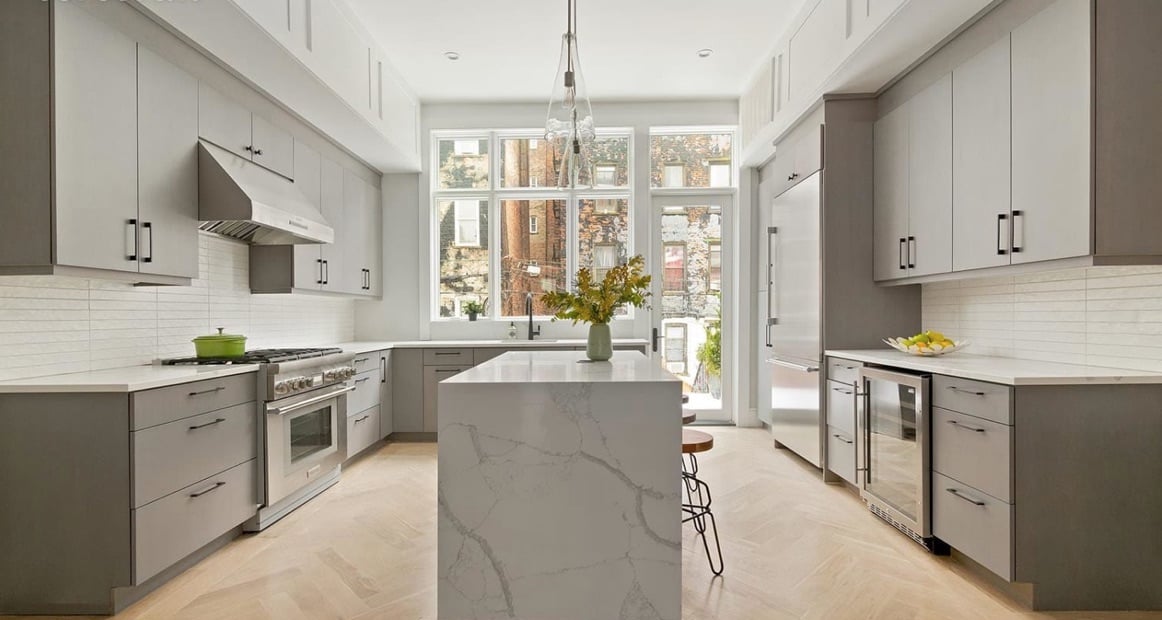
If you’ve watched house flipping shows on TV, you’ve noticed the designer or flipper’s first comment: “We can take down this wall and open up the kitchen.” Cue graphics of a wall disappearing and a chic breakfast bar taking its place. The open-plan kitchen brings the home’s most important room into the center of the action. Food prep and cooking no longer has to be solitary, and snacking in front of the TV is easier than ever. Modern kitchens can’t drag behind the rest of the home aesthetically; raggedy cabinets and outdated appliances are now a thing of the past.
A Brief History
Open-plan kitchens have been in vogue since the early 1990s, generally reserved for new constructions where support joists allowed free-flowing layouts. Five years ago, the New York Times raised eyebrows with an article proclaiming “The Closed Kitchen Makes a Comeback,” but evidence is limited. Most new condos in New York have open-plan kitchens, and townhouses are increasingly adopting the trend. Older condos or co-ops may still forbid wall removal. So, is an open-plan kitchen all it’s cracked up to be? Let’s dig deeper.
Open Plan Kitchens in NYC Townhouses
Historically, kitchens in NYC townhouses were in the basement, sometimes where servants worked. Recently, kitchens are moving to the parlor floor, becoming the centerpiece of the home. Renovations in century-old townhouses are costly, requiring breaking brick walls and re-running pipes, often opening a back wall to create a light-filled focal point. Large marble or quartz islands, breakfast bars, state-of the-art appliances, and chic light fixtures now redefine modern NYC townhouse kitchens.
Condos
Almost every newly constructed or renovated condo, including many listings in Brooklyn and Manhattan, features an open-plan kitchen. Luxury appliances now come in compact sizes, so even a 500 sq ft condo can have a sleek, fully equipped kitchen integrated with the living space. Larger condos in more formal buildings are sometimes reverting to separation, making sliding doors a valuable asset.
Kitchen Trends
Kitchens in fashionable cities have embraced color over the last decade. Stainless steel is no longer mandatory, and cabinets aren’t limited to brown or white. Luxury brands like Gaggenau, Miele, LG, GE, Viking, Blue Star, and Bertazzoni offer stylish appliances in blues, grays, and metallic slate finishes, popular in 2021. Panel-ready appliances that match colorful cabinets allow designers to create a seamless flow throughout the home.
The Case for Closed Kitchens
An open-plan kitchen can feel like dating a trophy spouse: always expected to look good. If staying on top of trends and keeping everything spotless is too much pressure, a wall separating the kitchen from the living room is a valid option.
Serious Chefs Don’t Want Distractions
For serious cooking, chefs may prefer privacy. An open-plan kitchen doesn’t allow for solitude while preparing meals.
Some Smells Belong Behind Closed Doors
Boiled cabbage, steamed fish, or chopped onions sometimes belong behind closed doors. Not all culinary scents should pervade the rest of the home.
Small Children and Hot Pots Don’t Mix
If small children are in the home, hot pots, pans, knives, and even cleaning products can pose hazards, making a closed kitchen a safer choice.
Summary
To be open or closed is a matter of individual taste. Closed kitchens may be harder to find in new or renovated homes, but a partial opening or hybrid layout can provide the best of both worlds. Older homes and condos still often feature closed or galley kitchens, which may suit those who prefer separation and privacy.
