Search for things to do in Turtle Bay this summer, and the conventional answer is an events list. That misses how this part of Manhattan actually works.
The Turtle Bay Association’s current calendar lists no neighborhood events in July or August. Its next listed major gathering is the second annual Taste of Turtle Bay on October 3. That absence is useful. Summer here is less about headline programming than a dependable sequence of small, well-run places.
Between Second and Third Avenues, principally from East 43rd Street through the low East 50s, the day has a clear rhythm. Breakfast can begin before the sidewalks heat up. Lunch can disappear below street level or settle beside a waterfall. Wednesday adds regional farms to East 47th Street. Early evening belongs to seafood, historic townhouse blocks and a discreet new cocktail room. Film and late-night diner service carry the neighborhood beyond dinner.
Turtle Bay’s summer advantage is compression. A pocket park, landmarked residential streets, destination dining, cultural institutions and late-night service all sit within a short walk.
The waterfall hour
At 217 East 51st Street, Greenacre Park functions as practical summer infrastructure.
The three-level park was designed by Hideo Sasaki and opened in 1971. It is privately owned and maintained by the Greenacre Foundation and listed on the National Register of Historic Places. Mature honey locust trees, movable tables, an outdoor café and a 25-foot waterfall create distinct places to sit within a compact address.
The waterfall matters for more than appearance. Its sound helps screen the surrounding street noise, changing the character of a midday break without requiring a trip out of Midtown. That is why Greenacre earns a place in a resident’s routine rather than a one-time sightseeing itinerary.
A recent city planning inventory describes the park as generally accessible from dawn to dusk and in excellent condition. Exact access can change, so checking before a dedicated visit remains sensible.
The strategic hour is the one between appointments. Bring lunch, take a table if one is available, and let the waterfall reset the pace of the day. Greenacre proves the central point of these blocks: their most valuable summer spaces are often the smallest and most carefully maintained.
Wednesday changes the neighborhood’s inventory
The week gains a different texture on Wednesday morning. The Dag Hammarskjöld Plaza Greenmarket operates year-round from 8:00 a.m. to 3:00 p.m. on East 47th Street between First and Second Avenues, directly beside the eastern edge of this route.
The current producer list is unusually broad for a compact Midtown market:
- Big Apple Fungi brings mushrooms and tinctures.
- Catch of the Hamptons supplies seafood.
- Francesca’s Bakery offers breads, quiches and sweets.
- Hawthorne Valley Farm brings organic and biodynamic produce, meat, dairy, baked goods and fermented vegetables.
- Juquilita C T Farm specializes in vegetables and Mexican herbs.
- Norwich Meadows Farm supplies certified organic vegetables.
- Samascott Orchards and Nine Pin Ciderworks bring orchard fruit, cider, vegetables and baked goods.
- Terhune Orchards offers fruit, vegetables, flowers and baked goods.
This is not a decorative market stop. It can supply dinner, flowers and provisions for several days. The roster also explains something about Turtle Bay’s weekday character. Residents, office workers and people connected to nearby international institutions share the same narrow corridor, giving the market a practical midday audience.
For a summer routine, Wednesday is the day to start east of Second Avenue, shop early and return west through the neighborhood before lunch.
The garden blocks reward a slower pass
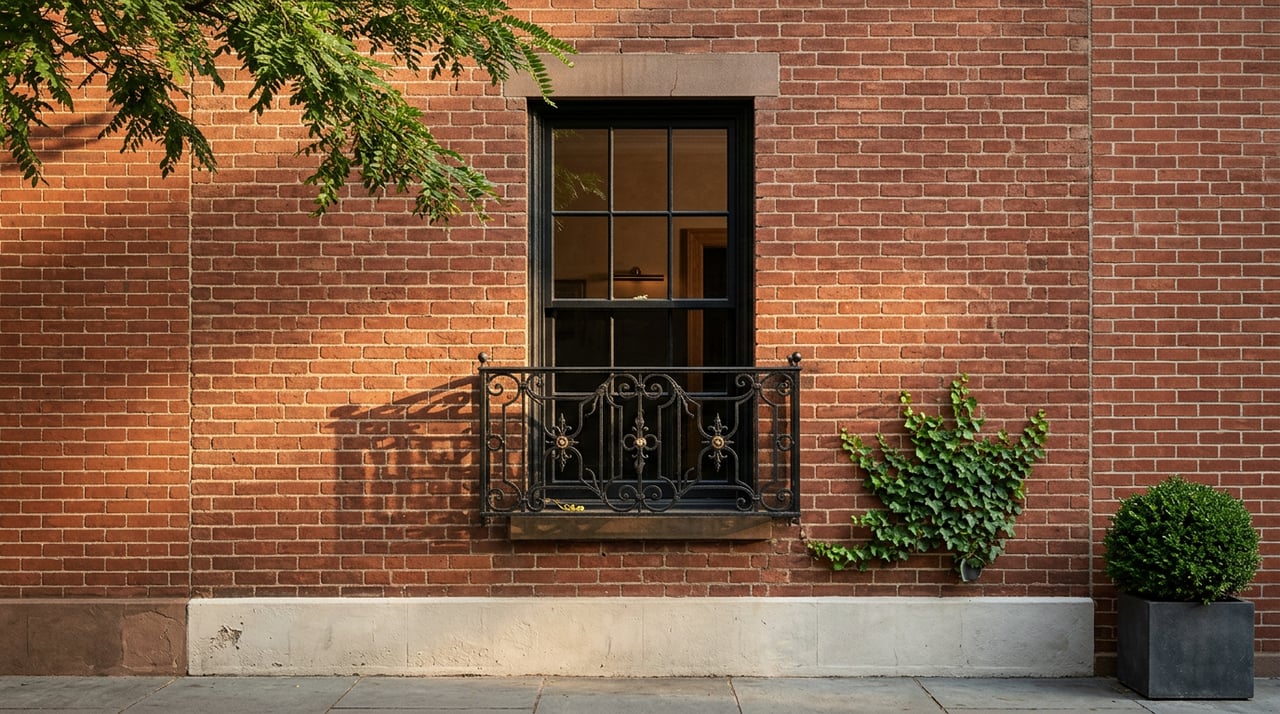
East 48th and East 49th Streets offer a different form of relief. The Turtle Bay Gardens Historic District contains 20 adjoining rowhouses organized around a shared interior garden.
The houses largely date from the 1860s. Around 1918 to 1920, Charlotte Martin, also known as Charlotte Hunnewell Sorchan, transformed the group into the garden enclave recognized today. Katharine Hepburn acquired a house there in 1932 and retained it until her death in 2003.
The interior garden is private. The appropriate experience is from the public sidewalk, where the façades, balconies and glimpses of planting make the two streets worth taking at a deliberate pace. This is architecture as part of a daily walk, not an invitation to enter private space.
Nearby, Amster Yard at 211–215 East 49th Street now houses Instituto Cervantes New York. The institution promotes Spanish-language learning and the cultures of Spanish-speaking countries. Access can depend on its hours and programming, so treat it as a cultural address to check rather than an always-open courtyard.
Together, the district and Amster Yard show why these midblocks feel distinct from the avenues. The avenues carry service and movement. The side streets hold design, history and institutional life.
East 43rd Street offers two forms of retreat
At the southern end of the route, two Japanese dining addresses provide different responses to a hot or rain-heavy day.
Sushi Yasuda at 204 East 43rd Street serves lunch from noon to 3:00 p.m. Monday through Friday and dinner from 6:00 to 11:00 p.m. on weekdays. Saturday dinner runs from 5:00 to 11:00 p.m., and the restaurant is closed Sunday. Its established schedule makes it a credible option for a planned lunch or evening reservation rather than an improvised stop.
At 211 East 43rd Street, Sakagura takes the experience below grade. Its izakaya-style menu and sake focus offer a deliberate indoor counterpoint to the summer street. Current hours include weekday lunch and dinner Monday through Saturday, with Sunday closure.
These are not interchangeable recommendations. Sushi Yasuda suits the reservation built into the day. Sakagura offers a more concealed setting when the weather makes street-level dining less appealing. Their proximity illustrates the neighborhood’s underlying efficiency: a single block can hold more than one credible version of lunch or dinner.
Second Avenue carries the early evening
Summer visibly changes New York’s restaurant streets. Under Dining Out NYC, approved roadway cafés may operate from April 1 through November 29, while approved sidewalk cafés can operate year-round. The rule helps explain the seasonal return of open-air seating, although individual restaurant participation should always be confirmed.
At 945 Second Avenue, Crave Fishbar supplies one of the clearest early-evening rituals. The restaurant describes itself as New York City’s first 100 percent sustainable seafood restaurant and the city’s first restaurant partner of Monterey Bay Aquarium. Its Oystergram happy hour and Monday buck-a-shuck offer provide a specific reason to choose the bar rather than simply adding another dinner reservation.
Next door, Crave Sushi Bar occupies a late-19th-century Turtle Bay townhouse at 947 Second Avenue. Its menu emphasizes domestic fish and fisheries recommended through the group’s Seafood Watch relationship. The two adjacent concepts create useful optionality: oysters and a broader seafood menu at one address, sushi in a townhouse setting at the other.
Then there is the neighborhood’s timekeeper. Morning Star Cafe at 949 Second Avenue has been family-owned since 1998. It operates from 6:30 a.m. to 11:30 p.m. Monday through Wednesday and Sunday, then remains open 24 hours from Thursday through Saturday.
That schedule gives the same short stretch of Second Avenue an unusual span. It can handle breakfast, an oyster-hour meeting, dinner and a late return without requiring a change of neighborhood.
Friday adds a new room on Third Avenue
High above the western edge of the route, Highball Ltd. is the most relevant 2026 opening.
The cocktail bar sits on the 11th floor of 10 Grand Central. Entry is through the freight-elevator entrance at 708 Third Avenue between East 44th and East 45th Streets, not through Grand Central Terminal. The team behind PDT created the room around a golden-age rail-travel reference.
Its published schedule is Monday through Thursday from 5:00 to 10:00 p.m. Summer Fridays run from 3:00 to 8:00 p.m. That earlier Friday window makes Highball part of the neighborhood’s summer cadence rather than merely another after-dinner bar.
The format is best approached with accurate expectations. It is a recent, carefully themed cocktail room with an unconventional entrance and limited evening hours. That is enough to make it useful without overstating consensus around a new venue.
Culture continues just east of the avenue
Japan Society at 333 East 47th Street provides the season’s most substantial cultural program. JAPAN CUTS 2026 presents more than 30 films, spanning premieres, restorations, documentaries, shorts and anime.
This year’s highlights include Suzu Hirose receiving the CUT ABOVE Award, the New York premiere of A Pale View of Hills and Hirokazu Koreeda’s appearance for the North American premiere of Sheep in the Box.
Japan Society’s main festival page gives a July 8–18 date range, while its film archive lists Sheep in the Box on July 19. The individual listings are the prudent guide. Remaining archive dates include Night Flower on July 16, Burn and TIGER on July 17, and Numb and SUZUKI=BAKUDAN on July 18. Confirm tickets and screening times directly before going.
The Japan Society gallery is closed for the summer and scheduled to reopen October 6 for Gen’ichiro Inokuma’s NYC Salon. For now, film and other scheduled cultural programming are the reasons to make the walk east.
A concise summer operating plan
| When | The move |
|---|---|
| A fair midday | Use Greenacre Park as a short, intentional pause. |
| Wednesday morning | Shop the Dag Hammarskjöld Plaza Greenmarket before 3:00 p.m. |
| Monday evening | Check Crave Fishbar’s buck-a-shuck offer. |
| Friday afternoon | Consider Highball Ltd.’s 3:00 to 8:00 p.m. Summer Friday hours. |
| Thursday through Saturday late | Use Morning Star Cafe’s 24-hour schedule. |
| A hot or wet evening | Shift indoors to Sakagura, Sushi Yasuda or a Japan Society screening. |
Two citywide programs can extend that plan. NYC Restaurant Week Summer 2026 runs July 20 through August 16, with more than 600 participating restaurants offering $30, $45 or $60 prix-fixe meals. Saturdays are excluded, and Sunday participation is optional. Use the official live filters before assuming any Turtle Bay restaurant is participating.
Manhattan Summer Streets takes place August 1, 8 and 15 from 7:00 a.m. to 3:00 p.m. Its principal corridor lies west of this Second-to-Third Avenue focus, but it gives residents a credible Saturday extension toward Park Avenue and beyond.
The blocks are the program
Turtle Bay does not need a packed July calendar to sustain a full summer day. Its value lies in dependable access to several different kinds of city life within a compact area.
Greenacre Park provides the pause. The Greenmarket supplies the week. Turtle Bay Gardens gives the side streets architectural weight. East 43rd Street handles destination dining, Second Avenue carries the long day, and Highball Ltd. adds a new Friday ritual. Japan Society contributes programming with an international perspective.
That is the neighborhood’s actual summer rhythm. It is measured less by major events than by how readily a resident can move from one useful room to the next.
For discreet, founder-led guidance on New York property decisions where block-level knowledge matters, connect with The Bracha Group.
Work With Us
